





Trading With a Small Forex Account: What You Need to Know
 Oct 16,2026
  By admin
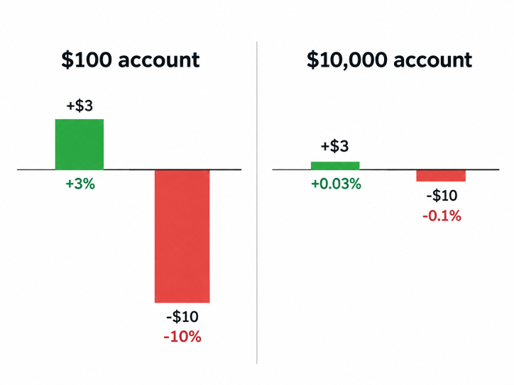
A $100 account needs only a $10 loss to be down by 10%. On a $250 account, the same loss comes to 4%, while a trader starting with $500 would lose 2%. In all three cases, the dollar amount is fairly small. The effect on the account is not.
That convenience, however, creates an unusual problem. A trader may be happy to start with $100, but usually does not want $100-sized results.
For instance, making $3 from a trade on a $100 balance equals a 3% return. Percentage-wise, that is already considerable. Yet, after waiting several hours for an entry, $3 may look hardly worth the effort. This is often when the lot size starts increasing.
How Small Is a Small Trading Account?
There is no universal figure for what is considered a small trading account. A professional trader may consider $10,000 small, whereas someone opening their first live account may be working with $100.
For this article, a forex small account means roughly $100 to $500. Accounts of this size are large enough to place real trades with many brokers, although they are also small enough for lot size, trading costs and a few losses to become significant rather quickly.
| Account balance | 1% of the account | 2% of the account |
|---|---|---|
| $100 | $1 | $2 |
| $250 | $2.50 | $5 |
| $500 | $5 | $10 |
Nevertheless, changing the risk from $1 to $10 changes the situation considerably. The trader is no longer risking a small part of the balance. One losing trade now removes 10%, and another identical loss leaves only $80.
Suppose a trader wants to risk $1 on a particular EURUSD trade, but the stop required by the setup means that even the minimum available position of 0.01 lot puts more than $1 at risk. The trader now has three choices: accept more risk, alter the original setup or leave the trade.
Moreover, the same lot size does not have the same monetary effect across every instrument. A trader accustomed to 0.01 lot on a currency pair may use 0.01 on gold and discover that price movement affects the account quite differently.
Position Size, Leverage and the Problem With a $100 Balance
Assume that a trader has $250 and wants the maximum loss on a trade to remain around $5. One setup may require a 20-pip stop, while another requires 40 pips. If exactly the same position is used on both, the second trade can lose considerably more before reaching its stop.
The lot size therefore cannot always remain fixed simply because the account balance has not changed.
As an example, a broker offering high leverage may allow a trader with $100 to open a position far larger than the balance would suggest. The required margin may still be quite small, and there may even be enough free margin left to enter another position.
If that position moves against the trader by an amount equal to $15, then $15 has disappeared from the $100 balance. It makes little difference that only a fraction of the position value was required as margin.
Consequently, discussions about the best leverage for small trading account can become misleading when position size is ignored. A high leverage setting does not require a trader to use a large position. It merely makes one available.
Losses on a forex small account become progressively harder to recover as well. If $100 falls to $90, a gain of roughly 11.1% is required to return to $100. At $80, the required gain becomes 25%. Should the balance fall to $50, the account needs to double merely to return to where it began.
Why Growing a Small Account Quickly Is So Attractive
The idea of turning $100 into $1,000 attracts attention for an obvious reason. The starting amount looks manageable, while the final number looks meaningful.
A trader searching how to grow a small trading account will find account flips, screenshots, challenges and examples of very large percentage returns. Some of them may be genuine.
Suppose someone wants to take $100 to $500. The required gain is 400%. A move from $500 to $1,000 requires another 100%. Such returns can certainly occur, although producing them within a short period usually means accepting considerably more risk than someone seeking gradual growth would accept.
A $100 balance becomes $120. Another trade takes it to $145, and increasing the position again feels quite logical because the account is larger than before. If the next several trades also win, the small account trading challenge appears to be working exactly as intended.
A larger position that helped move the account from $120 to $145 can also remove a sizable portion of that balance on the next trade. After several increases in lot size, a relatively ordinary losing streak may return the account close to its starting point, or below it.
For instance, a trader may wait through most of the London session, finally take a good EURUSD setup and close the position with a $4 gain on a $150 balance. The trade itself went well. Still, the trader may look at four dollars and immediately begin searching for another entry.
The position on gold is made larger because the first trade did not produce enough in dollar terms. At this point, the second trade has very little to do with EURUSD or with the original plan. The trader is trying to make the day financially worthwhile.
Accordingly, a few habits appear repeatedly:
- Increasing the position after a small profit because the return seems insignificant;
- Taking additional trades merely to reach a daily amount
- Holding a losing position longer because accepting the loss would remove too much of the account
- Increasing risk after a losing trade in an attempt to recover it
- Using a large part of the available margin because the broker permits it
What Should You Expect From a Forex Small Account?
For a trader leaving demo trading, even a $100 forex small account changes the experience. Demo trading cannot reproduce all of that particularly well.
If someone deposits $200 to learn live execution, test a forex small account strategy and find out how they behave with actual money involved, the account can do its job without producing meaningful monthly income.
If the same $200 is expected to generate $300 each month, the situation becomes very different. The required return would be 150% every month before considering losing periods.
For traders wondering how to trade forex small account, several things are worth considering before attempting to increase the balance:
- Decide how much of the account can be lost on one trade before selecting the lot size.
- Check the minimum contract size before trading a new market.
- Allow the position to become smaller when the stop needs to be wider.
- Avoid creating a daily profit requirement when no suitable trade has appeared.
- Do not assume available margin means the account can comfortably afford another position.
For example, a gold setup may require a stop that creates too much monetary risk even at the broker’s minimum position. Moving the stop several dollars closer simply to fit the account can turn a reasonable setup into a completely different trade.
Bottom Line
With that said, a forex small account does not necessarily need to grow quickly to be useful. Learning to size trades, sit through a loss and follow a plan with actual money involved can have considerably more value than turning $100 into $200 once and being unable to repeat it.