






Stop-Loss Hunting in Forex: Is It Real or Just a Trading Myth?
 Oct 09,2026
  By admin
Stop loss in forex is one of the first risk management tools traders come across, and also one of the most complained-about. A trader places the stop below a support level, price drops just enough to hit it, and shortly afterward turns back in the expected direction. After seeing this happen a few times, it is quite easy to start believing that someone is deliberately looking for those stops.
This idea is usually referred to as stop loss hunting.
It has become especially common in forex communities where traders share screenshots of sharp wicks around previous highs, lows, support zones, and round numbers. In many of these examples, price crosses the obvious level, triggers a group of stops and then quickly reverses. From the chart alone, the movement can certainly look suspicious.
With that said, the forex market also naturally attracts large amounts of trading activity around obvious price levels. Traders tend to use similar technical references, which means their stop orders often end up sitting in the same areas. Therefore, a move through those levels does not always prove that a broker or another market participant deliberately hunted individual traders.
So, is stop loss hunting in forex actually real, or has the phrase become a convenient explanation for a normal market move that ended badly?
What Is Stop Loss in Forex and Where Do Traders Usually Place It?
A stop loss in forex is an order used to close a position after price reaches a specified level. If a trader buys EURUSD and the market begins moving lower, the stop limits how far the trade is allowed to run against the position.
For example, someone buying EURUSD around 1.1700 may decide that the trading idea is no longer valid below 1.1660 and place the stop somewhere around that area. If price reaches the stop, the position is automatically closed.
The actual difficulty comes from deciding where that level should be.
Many traders use recent highs and lows for stop loss placement. Buyers commonly place their stops below support or below the latest swing low, whereas traders holding short positions often put them above resistance or a recent high. Round numbers also attract attention because levels such as 1.1000 or 1.2000 are easy to notice and are watched by a large number of market participants.
Consequently, the stop loss in forex is rarely scattered randomly across a chart. Orders tend to collect around the same visible places.
This matters because forex liquidity is also linked with where orders are available. When price reaches an area containing many orders, more transactions can take place there. A level that appears important to a retail trader can also be important simply because a lot of buying and selling interest is sitting around it.
What Actually Happens During Stop Loss Hunting?
Stop loss hunting generally describes a situation where price moves into an area containing a large number of stop orders, triggers them, and then moves away again.
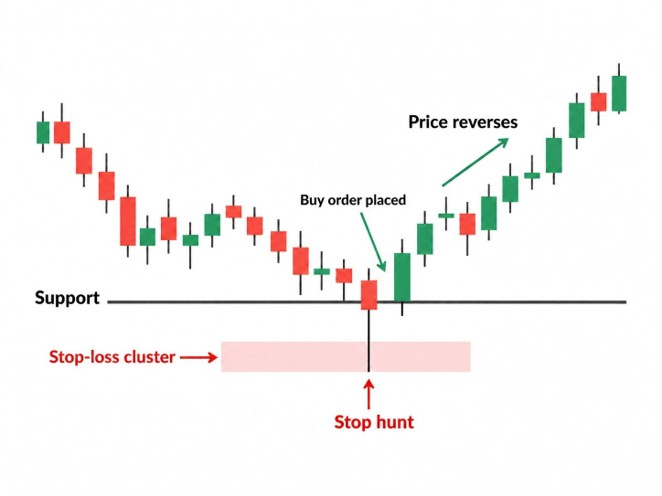
Suppose a currency pair has repeatedly failed to move below the same support level. Traders looking at the chart can easily identify that low, and some of them may buy above it while keeping their stop slightly underneath. As more traders follow the same idea, a group of stops begins collecting below that support.
Now, if price eventually trades below the level, those stops are activated.
A stop on a long position effectively becomes an order to sell. If many stops are triggered within a small price area, the number of sell orders suddenly increases. This can contribute to a fast downward move, even if the price later recovers.
The same thing can happen above a recent high. Traders who sold earlier may have stops sitting just above it, and once price reaches that area, those orders enter the market.
Interestingly, this is also why stop loss hunting in forex is often discussed together with terms such as liquidity grab forex or liquidity sweep. A price can briefly move through a previous high or low, collect orders in that area and then reverse.
Liquidity naturally exists around these levels because traders place orders there. Large market participants also need enough opposite orders when entering or exiting sizeable positions. As a result, price moving toward liquidity can happen without anyone specifically deciding to target a particular retail trader.
A chart only shows the movement afterward. It does not show the intention behind every order that caused it.
Is Stop Loss Hunting Real or Just a Trading Myth?
That does not mean every stop taken out by a wick was deliberately hunted.
For instance, high-impact economic news can produce a sudden expansion in volatility. Spreads can widen, liquidity can become thinner, and price may travel through several nearby levels before settling. A stop sitting only a few pips below support can easily be triggered during such a move.
Similar situations can happen without news. During less liquid trading hours, even an ordinary order can produce more movement than it would during an active session.
Moreover, traders sometimes place their stop loss in forex exactly where almost everyone looking at the same chart would expect it. A recent low has already been tested several times, so the stop goes two or three pips below it. When price finally trades through the low, the trader feels personally targeted even though hundreds or thousands of other orders may be sitting around the same point.
Can a Broker See Your Stop Loss?
A broker handling a trader’s order can generally see the stop level stored within its trading system. This is one reason broker stop loss hunting receives so much attention among retail traders.
Still, knowing that a stop exists and deliberately manipulating price to trigger it are two different things.
The wider forex market is enormous, and moving it simply to close one small retail position would make little economic sense for a properly operating broker. The more relevant concern arises when traders use poorly regulated or dishonest brokers where pricing, spreads, slippage or trade execution cannot be trusted.
A suspicious price spike can also be checked against other market feeds. If the same movement appears across several major platforms, the explanation is unlikely to be one broker hunting a specific stop. If one broker alone shows an unusual price movement that triggered orders while comparable feeds did not, the situation deserves much more attention.
How to Avoid Stop Loss Hunting Without Ruining the Trade
Trying to avoid stop loss hunting does not mean placing the stop at a strange level simply because other traders are unlikely to use it. The stop still has to relate to the trading idea.
One common mistake is placing the stop only a few pips beyond an obvious high or low. If the market normally moves much farther than that during an ordinary session, such a tight stop can be triggered even when the overall setup remains valid.
A forex stop loss strategy should therefore consider how much price usually moves, where the setup actually becomes invalid, and how much money the trader is willing to risk.
Some points worth checking include
- Current volatility of the currency pair
- Nearby highs, lows and other obvious technical levels
- Upcoming economic releases
- Position size if a wider stop is required
- Whether the trade still offers reasonable risk and reward
Some traders use Average True Range when deciding how to place stop loss in forex because it gives an idea of recent price movement. Others prefer market structure and place the stop beyond the point where the original setup would clearly be wrong.
Suppose a trader buys because a wider support zone is expected to hold. Keeping the stop inside that same zone can cause trouble because price can move around within the area without completely breaking it.
On the other hand, simply moving every stop far away is not a sensible answer either. A wider stop increases the potential loss unless the position size is reduced accordingly.
A properly placed stop loss in forex should sit where the trading idea has genuinely weakened or failed, while still respecting the amount of risk the trader can afford. That does not guarantee that a stop will never be triggered before a reversal. It simply gives the trade a better reason for having the stop where it is.