






A Guide to Forex Sessions: What Timing Tells You About Volatility
 Oct 23,2026
 By admin
Imagine entering a busy supermarket on a Saturday afternoon. The aisles are packed, items are moving off the shelves quickly, and checkout lines are moving fast. Now, imagine visiting that same store at 3:00 AM on a Tuesday. The building is the same, but the activity is dead quiet.
The forex market works the exact same way.
Even though forex is open 24 hours a day, 5 days a week, the market doesn’t move at the same speed all day. Traders call that speed volatility: how sharply and significantly a currency pair’s price fluctuates over a given period. This is directly tied to the opening hours and overlaps of major global trading sessions, which dictate when the market experiences its highest liquidity and movement.
Let’s break down the three main forex trading sessions step by step, see what their volatility means for your account, and look at simple examples of how to trade each one safely.
Understanding the Clock: The Three Big Sessions
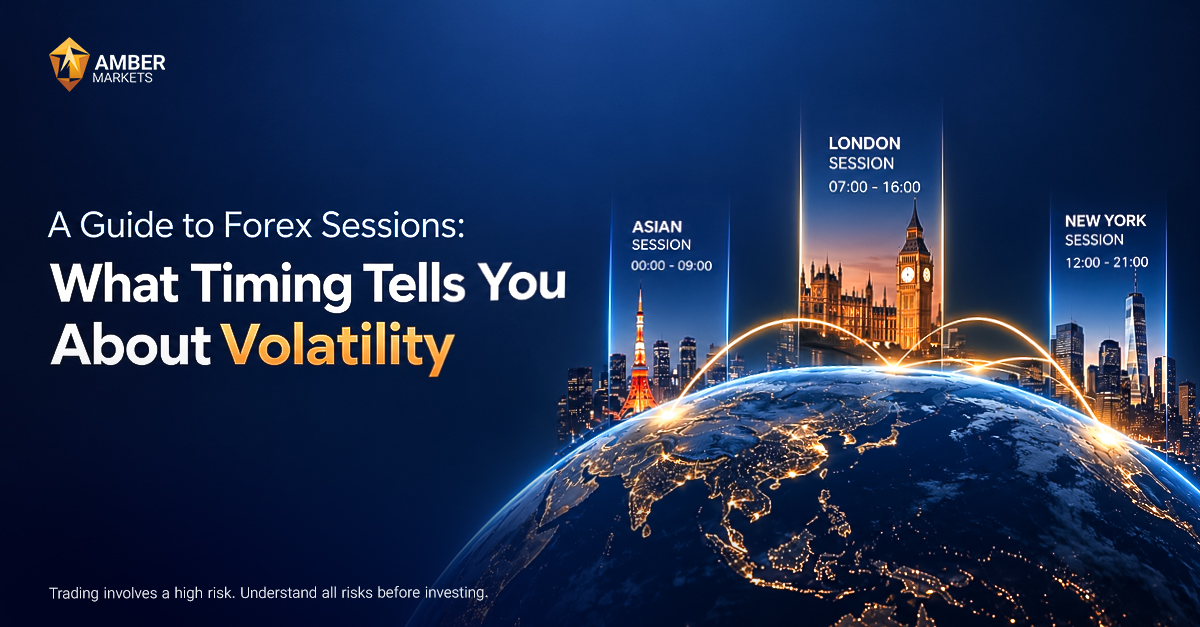
Because the Earth rotates, trading passes like a relay baton from East to West across three primary centers:
| Session Name | Key Financial City | Typical Hours (GMT) | Share of Global Trading | FX Volatility Level |
|---|---|---|---|---|
| Asian Session | Tokyo/Singapore | 00:00-9:00 GMT | ~21% combined | Low to Moderate |
| London Session | London | 7:00-16:00 GMT | ~38% (Single biggest hub) | High & Directional |
| New York Session | New York | 12:00-21:00 GMT | ~19% (Second biggest hub) | Very High (News-Driven) |
1. The Asian Session: The Quiet Accumulation Phase
Think of the Asian session as the market taking a deep breath.
Because major banks in Europe and North America are closed, the total money moving through Western pairs like EUR/USD or GBP/USD drops sharply.
What Forex Volatility Looks Like Here:
- Tight Ranges: Prices tend to bounce back and forth between clear support (floor) and resistance (ceiling) levels.
- Small Pip Movements: On a pair like EUR/USD, price might move only 7 pips an hour.
- Low Follow-Through: If price suddenly jumps up, it often runs out of gas and drifts right back to where it started.
Real-World Example:
Suppose EUR/USD starts the Tokyo morning at 1.0820. Over the next six hours, it climbs to 1.0835, drops down to 1.0815, and finishes around 1.0822. A beginner who tries to catch a “huge breakout” here will usually end up frustrated because the big banks needed to push that move simply aren’t at their desks yet.
2. The London Session: The Trend Starter
London is the true engine room of foreign exchange. The BIS reports that the UK handles nearly 38% of all global currency trades; double that of the United States.
When European and UK banks open their doors, a rush of institutional volume hits the market.
What Forex Volatility Looks Like Here:
- The "Morning Fakeout: In the first 30 to 60 minutes, London traders often push the price briefly past the Asian high or low just to trigger beginner stop-losses and grab available orders. Once that liquidity is collected, price snaps back and starts the real move of the day.
- Real Breakouts: When a currency breaks out of a price level during the London morning, it usually keeps going in that direction for several hours.
- Tight Spreads: Because volume is huge, brokers offer the lowest transaction costs (spreads) of the day on European currencies.
Real-World Example:
During Asia, GBP/USD was stuck between 1.2680 and 1.2700. At 07:15 GMT, London opens, and the price drops quickly to 1.2670 (scaring buyers into closing trades). Fifteen minutes later, huge institutional buying enters, pushing the pair straight up to 1.2760 over the next three hours.
3. The London / New York Overlap: The "Power Hours"
Between 12:00 GMT and 16:00 GMT (13:00- 17:00 GMT in winter), both London and New York are open at the same time. Together, these two centers control more than 55% of all daily trading volume.
What Forex Volatility Looks Like Here:
Explosive Moves: Scheduled US releases like Inflation (CPI) and Jobs data (NFP) published monthly at this overlap can send prices moving 50–100 pips within minutes.
Fast Execution: Slippage can happen during major news headlines because quotes move faster than normal.
4. Late New York: The Cooldown
After 16:30 GMT, London closes down for dinner, and European traders head home. Only the New York desk remains active.
During this window, volume drops sharply. Big institutions spend the last few hours of their workday closing out open trades, balancing books, and preparing for the end-of-day rollover; 5:00 PM NY time (21:00/22:00 GMT).
What it means for you:
Avoid opening fresh trades here. The market frequently drifts sideways, and spreads widen noticeably as the day officially turns over.
Quick Cheat Sheet: Matching Strategy to the Session
| If your personality prefers… | Your ideal market condition is… | Best session to trade | Recommended pairs |
|---|---|---|---|
| Calm, slow trades | Small ranges, predictable bounds | Asian Session | EUR/CHF, EUR/GBP |
| Catching big trends | Strong directional pushes | London Session | GBP/USD, EUR/USD |
| Fast action & momentum | Explosive volume and fast moves | London / NY Overlap | EUR/USD, XAU/USD |
Final Takeaway: Ride the Waves, Don’t Fight the Tide
Forex trading isn’t about staring at charts 24 hours a day; it’s about knowing when to strike. Think of the global sessions as ocean tides: trying to catch massive trends during the flat, quiet waters of the Asian session will only exhaust you, just as swimming against the heavy waves of the London-New York overlap without a plan will pull you under.
Master your clock, match your strategy to the session’s rhythm, and remember…in forex, timing isn’t just everything; it’s your ultimate edge.