





How Non-Expiry Futures CFDs Work: Rollover, Costs and Trading Conditions
 Oct 02,2026
  By admin
Futures expiry can look like a small technical detail until a position is still open when the contract reaches its final day. A standard futures contract cannot run forever. It expires, and trading activity then shifts to a newer contract with a later expiry date. Non-Expiry Futures CFDs handle that change differently. The CFD can remain open while the price source switches from the expiring futures contract to the next one.
What changes when a futures contract expires?
Every futures contract has a set expiry date. As that date approaches, the market begins using the next active contract. Those two contracts are separate instruments and they do not have to trade at the same price. One can be slightly higher or lower than the other, even when both track the same underlying market.
That difference matters for a Non-Expiry Futures CFD because the chart has to start following the new contract. If the old contract is trading at one price and the next contract is trading at another, the switch can show up as a gap. Without an adjustment, that gap could make the open position appear to gain or lose value simply because the price source changed.
How a Non-Expiry Futures CFD keeps a trade open
A Non-Expiry Futures CFD follows the currently active futures contract, but the CFD itself does not carry an expiry date for the trader to manage. When the underlying contract expires, the open CFD trade is not closed and a new trade is not opened in its place. The price source changes, then a rollover adjustment is used to account for the gap between the two futures
- The position can remain open while the underlying futures contract changes.
- The trade itself is not moved, closed or reopened during rollover.
- A rollover adjustment accounts for the price difference between the expiring contract and the new contract.
Why the rollover adjustment matters
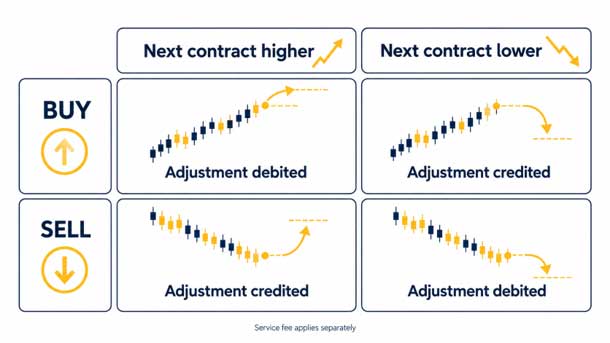
The purpose of the rollover adjustment is to separate a contract switch from an actual market move. If the new contract starts at a lower price, a BUY position would show a lower floating P/L after the switch. If the new contract starts at a higher price, the same BUY position would show a higher floating P/L. The direction is reversed for a SELL position.
The balance adjustment works in the opposite direction of that chart gap. Apart from any service fee in the broker’s trading terms, the gap and the adjustment offset each other. This means the rollover itself does not artificially change the overall value of the position.
| Position | New contract LOWER than current | New contract HIGHER than current |
|---|---|---|
| BUY position | Floating P/L decreases, so the adjustment is credited | Floating P/L increases, so the adjustment is debited |
| SELL position | Floating P/L increases, so the adjustment is debited | Floating P/L decreases, so the adjustment is credited |
When does rollover take place?
Rollover takes place when the original underlying futures contract reaches expiry. The exact timing depends on the exchange calendar for that product, so there is no single rollover date that applies to every index, metal or energy contract. In practice, traders need to know the announced rollover time because only positions that remain open at that point are affected.
Trading Futures Non-Expiry CFDs with Amber Markets
Amber Markets offers CFDs on Futures, Non-Expiry through MetaTrader 5. The current range covers nine instruments across major indices, energy and metals. Their symbols end in ft.c and appear in MetaTrader 5 under Symbols > Futures Non-Expiry. All trading hours below are shown in GMT+3.
What the product setup looks like
- Nine Futures Non-Expiry instruments are available.
- Swap or overnight financing is not charged.
- Commission is not charged, while the spread remains floating.
- Maximum leverage is up to 1:100 and depends on the instrument.
- A rollover adjustment and a 1% rollover service fee apply when an eligible position remains open at the expiry of the underlying futures contract.
Available Futures Non-Expiry instruments
| # | Symbol | Product | Category | Currency |
|---|---|---|---|---|
| 1 | DOWft.c | Dow Jones 30 (DJIA30) | Index | USD |
| 2 | GERft.c | Germany DAX 40 | Index | EUR |
| 3 | NASft.c | NASDAQ 100 | Index | USD |
| 4 | SPXft.c | S&P 500 | Index | USD |
| 5 | USDXft.c | US Dollar Index | Index | USD |
| 6 | UKOft.c | Brent Crude Oil | Energy | USD |
| 7 | WTIft.c | WTI Crude Oil (West Texas) | Energy | USD |
| 8 | XAUft.c | Gold vs US Dollar | Metals | USD |
| 9 | XAGft.c | Silver vs US Dollar | Metals | USD |
Contract specifications and margin
Contract size is stated per 1 lot. Minimum and maximum trade size, lot step, margin, leverage and stop levels vary by instrument, so these figures should be checked before the order is placed.
Margin is calculated as a percentage of the position’s notional value using Price x Contract size x Lots. For example, 1 lot of XAUft.c at 4,176.00 has a notional value of 417,600 USD. At a 1% margin requirement, the required margin is about 4,176 USD. That amount changes as the market price changes.
Contract size and trade limits
| Symbol | Contract size | Digits | Min lot | Max lot | Lot step |
|---|---|---|---|---|---|
| DOWft.c | 10 | 2 | 0.01 | 100 | 0.01 |
| GERft.c | 25 | 1 | 0.01 | 100 | 0.01 |
| NASft.c | 20 | 2 | 0.01 | 100 | 0.01 |
| SPXft.c | 50 | 2 | 0.01 | 100 | 0.01 |
| USDXft.c | 100 | 3 | 0.01 | 100 | 0.01 |
| UKOft.c | 1,000 | 3 | 0.01 | 20 | 0.01 |
| WTIft.c | 1,000 | 3 | 0.01 | 20 | 0.01 |
| XAUft.c | 100 | 2 | 0.01 | 30 | 0.01 |
| XAGft.c | 5,000 | 3 | 0.01 | 30 | 0.01 |
Margin, leverage and stops
| Symbol | Margin | Leverage | Stops level |
|---|---|---|---|
| DOWft.c | 1% | 1:100 | 10 points |
| GERft.c | 1% | 1:100 | 10 points |
| NASft.c | 1% | 1:100 | 10 points |
| SPXft.c | 1% | 1:100 | 10 points |
| USDXft.c | 2% | 1:50 | 10 points |
| UKOft.c | 5% | 1:20 | 10 points |
| WTIft.c | 5% | 1:20 | 10 points |
| XAUft.c | 1% | 1:100 | 10 points |
| XAGft.c | 1% | 1:100 | 10 points |
Trading conditions
| Condition | Details |
|---|---|
| Instrument type | CFD on futures, cash-settled, no physical delivery |
| Spread | Floating |
| Swap / overnight fee | None |
| Commission | None |
| Rollover | Adjustment plus service fee at the expiry of the underlying futures contract |
| Execution | Market execution |
| Order types | Market, Limit, Stop and Stop-Limit orders, plus Stop Loss and Take Profit |
| Pending order validity | Good Till Cancelled (GTC), or with an expiry you set |
| Chart prices | Based on the Bid price |
| Hedged margin (Brent, WTI) | Calculated on the larger leg |
| Profit & loss currency | USD for all products, except GERft.c (EUR). EUR amounts are converted to your account currency. |
| Platform | MetaTrader 5 |
Trading hours (GMT+3)
| Symbol | Product | Monday | Tuesday – Thursday | Friday |
|---|---|---|---|---|
| DOWft.c | Dow Jones 30 (DJIA30) | 01:00 – 23:59 | 01:00 – 23:59 | 01:00 – 23:57 |
| GERft.c | Germany DAX 40 | 03:15 – 22:58 | 03:15 – 22:58 | 03:15 – 22:58 |
| NASft.c | NASDAQ 100 | 01:00 – 23:59 | 01:00 – 23:59 | 01:00 – 23:57 |
| SPXft.c | S&P 500 | 01:00 – 23:59 | 01:00 – 23:59 | 01:00 – 23:57 |
| USDXft.c | US Dollar Index | 03:00 – 23:58 | 03:00 – 23:58 | 03:00 – 23:55 |
| UKOft.c | Brent Crude Oil | 01:00 – 24:00 | 03:00 – 24:00 | 03:00 – 23:55 |
| WTIft.c | WTI Crude Oil (West Texas) | 01:00 – 23:59 | 01:00 – 23:59 | 01:00 – 23:55 |
| XAUft.c | Gold vs US Dollar | 01:00 – 23:59 | 01:00 – 23:59 | 01:00 – 23:57 |
| XAGft.c | Silver vs US Dollar | 01:00 – 23:59 | 01:00 – 23:59 | 01:00 – 23:57 |
How Amber Markets handles rollover
Before each rollover, Amber Markets emails clients with the product involved, the exact date and time in GMT+3, the current and estimated new contract prices, the estimated price gap and the service fee. The prices in that notice are estimates. The final adjustment uses the actual contract prices at rollover time.
The open trade stays in place. What appears on the account is the rollover adjustment and the rollover service fee, both posted to the account balance.
Rollover formula
| Step | Formula |
|---|---|
| 1. Price Difference | New Contract Price – Current Contract Price |
| 2. Gross Adjustment (BUY) | -1 x Price Difference x Lot Size x Contract Size |
| 2. Gross Adjustment (SELL) | +1 x Price Difference x Lot Size x Contract Size |
| 3. Service Fee | |Gross Adjustment| x 1% |
| 4. Final Posted Amount | Gross Adjustment – Service Fee |
A positive Final Posted Amount is credited to the balance, while a negative amount is debited. The 1% service fee is charged in either direction.
Worked example: WTIft.c, 0.10 lot
Assume the current contract price is 74.57 and the new contract price is 74.00. With a contract size of 1,000, the price difference is 74.00 – 74.57 = -0.57.
| BUY 0.10 lot | SELL 0.10 lot | |
|---|---|---|
| Gross Adjustment | -1 x (-0.57) x 0.10 x 1,000 = +57.00 | +1 x (-0.57) x 0.10 x 1,000 = -57.00 |
| Service Fee (1%) | |57.00| x 1% = 0.57 | |-57.00| x 1% = 0.57 |
| Final Posted Amount | 57.00 – 0.57 = +56.43 USD (credit) | -57.00 – 0.57 = -57.57 USD (debit) |
For the BUY, the new contract is 0.57 lower, so the floating P/L falls by 57.00 USD. A 57.00 USD credit offsets that change, then the 0.57 USD service fee is deducted. The final posted amount is therefore +56.43 USD.
For the SELL, the same lower contract price increases floating P/L by 57.00 USD. A 57.00 USD debit offsets that change, and the 0.57 USD service fee is also deducted. The final posted amount is -57.57 USD.
Rollover value per 1.00 price difference
A quick estimate starts with the value of a 1.00 price difference for one lot. Multiply the figure below by the actual price difference and the position size to estimate the gross adjustment.
| Symbol | Product | Contract size | Value per 1.00 price difference (1 lot) |
|---|---|---|---|
| DOWft.c | Dow Jones 30 (DJIA30) | 10 | 10 USD |
| GERft.c | Germany DAX 40 | 25 | 25 EUR |
| NASft.c | NASDAQ 100 | 20 | 20 USD |
| SPXft.c | S&P 500 | 50 | 50 USD |
| USDXft.c | US Dollar Index | 100 | 100 USD |
| UKOft.c | Brent Crude Oil | 1,000 | 1,000 USD |
| WTIft.c | WTI Crude Oil (West Texas) | 1,000 | 1,000 USD |
| XAUft.c | Gold vs US Dollar | 100 | 100 USD |
| XAGft.c | Silver vs US Dollar | 5,000 | 5,000 USD |
For example, XAUft.c has a contract size of 100. If the price difference is -5.00 and the position is 0.50 lot, the BUY Gross Adjustment is -1 x (-5.00) x 0.50 x 100 = +250.00 USD. The 1% service fee is 2.50 USD, which leaves a Final Posted Amount of +247.50 USD.
Key rollover rules to remember
- Rollover applies only to positions open at the announced rollover time. A position closed before that time is not affected.
- Positions opened after the rollover time are not affected because they open at the new contract price.
- The trade is not moved. The rollover adjustment and the 1% service fee are posted to the account balance.
- Prices in the rollover notice are estimates. The final adjustment uses the actual contract prices at rollover time.
- GERft.c adjustments are calculated in EUR and converted to the account currency.
- Enough free margin should be available because a debit reduces balance, equity and margin level.
Cost summary
| Cost | Non-Expiry Futures CFDs |
|---|---|
| Spread | Floating |
| Commission | None |
| Swap / overnight financing | None |
| Rollover | Price-gap adjustment plus a 1% service fee, only at the expiry of the underlying contract |