






What Is Price Action Trading in 2025 and How to Apply It
 Nov 13,2025
  By purvi Patel
Every few years, a new trading method takes the spotlight, such as algorithmic scripts, AI signals, automated bots, etc. Yet one approach never fades: price action trading. While technology evolves, traders still return to the raw language of price because it speaks clearly when everything else becomes unclear.
In 2025, price action trading feels more important than ever. Markets are faster, volatility is unpredictable, and decisions made in seconds can define outcomes. Price action remains the skill that turns complexity back into clarity.
The Idea Behind Price Action
At its core, price action is about reading what the market is doing rather than what you think it should do. It is the study of price movement, how it rises, falls, pauses, and reacts. Every candle tells part of that story.
A price action trader does not depend on a pile of indicators to interpret the market. Instead, they observe where price hesitates, where it breaks through, and how it behaves around those moments. It is the closest thing to seeing market psychology in motion.
Why It Still Matters in 2025
Technology has changed the tools of trading, not the nature of price. Indicators and algorithms can process data faster than ever, but all of them still react to the same foundation: price itself.
When inflation data, central bank comments, or unexpected news hit the market, the first thing that moves is price. Before an indicator confirms, the price has already spoken. That immediacy makes price action essential in a year defined by high-speed reactions and unpredictable events.
In volatile environments, traders who can read raw price behavior are often the first to understand when a move is genuine and when it is just false movement.
The Building Blocks of Price Action
Strong price action trading starts with observation. It focuses on three elements that repeat across every market and timeframe:
1. Structure
Markets create patterns. Higher highs and higher lows form uptrends, while lower highs and lower lows define downtrends. Recognizing structure shows who is in control: buyers or sellers.
2. Levels
Support and resistance zones act like memory points for price. When price revisits those areas, traders watch closely to see if old reactions repeat or reverse.
3. Behavior
Candlestick shapes reveal the tone of market emotion. Long wicks show rejection, strong bodies show building momentum, and small ranges show hesitation. Context transforms these details into meaning.
Each element contributes a clue. Together, they turn a plain chart into a readable story.
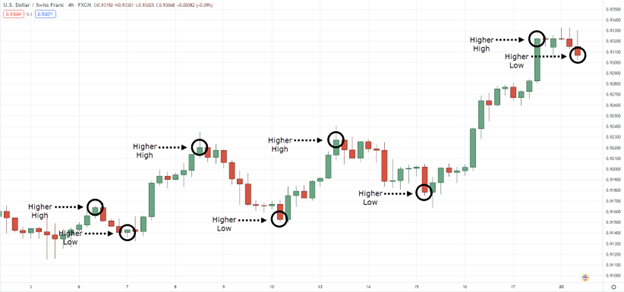
Applying Price Action in Real Trading
The beauty of price action is that it is simple to observe yet powerful in execution. A practical approach begins with preparation and patience.
Start with a clean chart. Identify the major direction using the hourly, daily, or four-hour timeframe. Mark the most visible highs and lows or other pivot areas where price has reversed or stalled before. These are your reference points.
Then wait. Let the price reach one of those areas and watch how it behaves. A strong rejection candle or a decisive close beyond a level signal that the market is revealing its next move.
An example might be gold retesting a former resistance at around 4,3800. If price jumps into that zone and forms a clear rejection pattern closing below the level, these candles carry information. It shows that sellers defended the zone and now is the time to sell. The setup is simple but built entirely on behavior, not on signals from lagging indicators.
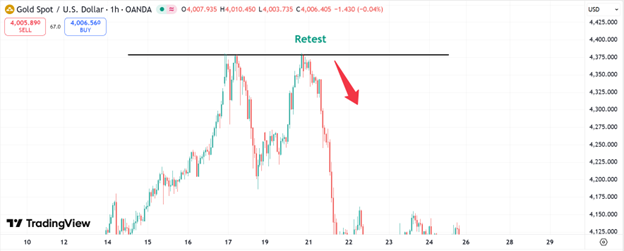
This approach rewards patience. It teaches traders to act on confirmation instead of anticipation.
What Makes It Stand Out
Price action trading appeals to professionals because it builds confidence and independence. Once a trader learns to read charts this way, they no longer rely on external systems.
It also adapts easily across instruments. The same logic works on forex pairs, commodities, or indices. And unlike mechanical systems that lose edge when markets change, price action adapts automatically. The rules of supply and demand never expire.
Common Errors to Watch For
Many traders misunderstand price action because they focus on patterns rather than purpose. The goal is not just memorizing shapes but to understand behavior.
Frequent mistakes include:
- Marking too many levels, which blurs the important ones
- Trading every candle formation without context
- Ignoring higher timeframes that show the larger story
- Taking trades before confirmation appears
Good price action trading is selective. It recognizes that missing a trade is better than entering one without evidence.
Learning from the Right Sources
Self-study remains the most effective path to mastering this skill, and the right resources make a difference. Several price action trading books stand out for their clarity and practicality.
“Naked Forex” by Walter Peters explains why removing indicators improves decision-making.
“Reading Price Charts Bar by Bar” by Al Brooks offers a deep examination of candle behavior.
“The Art and Science of Technical Analysis” by Adam Grimes connects price structure to trader psychology and risk management.
These works encourage analysis over automation. They teach how to think in probabilities, how to observe patiently, and how to trust the evidence that price presents.
The Mindset Behind the Method
The most skilled price action traders are calm observers. They do not chase every fluctuation. They wait for clarity, plan their entries, and execute without emotional attachment.
This mindset is not innate. It develops from repetition and review. Keeping a trading journal, marking screenshots, and reflecting on what worked and what failed are all part of the learning process.
Success with price action comes from consistent behavior, not constant action.
Final Thoughts
Price action trading is a core skill that sharpens with experience. For traders seeking to refine their craft in 2025, mastering price action offers provides a way to think based on observation, patience, and structure.
Those who invest time in studying price behavior and exploring reputable price action trading books develop a lasting advantage. They read markets clearly, act deliberately, and adapt confidently to change.
In a trading world full of automation, that clarity remains one of the rarest and most enduring edges of all.